This animation will form the centre of a triptych. This means that there will be an animation which will be shown either side of this one. As the animations are intended to be shown in portrait format and not landscape you will either have to tilt your head or your screen (or just use your imagination!) so that some of the figures etc make sense.
Each week I will add my work and would like people to comment on how the animations make you feel and what you think they mean. Criticism is more valuable than praise so don't hold back. Please send feedback to:
Julie.Garrod@student.nuca.ac.uk
Thanks!
Ego 1
Ego 2
Ego 3
Ego 4
Wednesday, 19 May 2010

Tuesday, 18 May 2010
Update 4
Today's effort was infinitely more successful than the last from a technical perspective. I moved into room 98 which has a much better light-box so I eliminated the problem of the flickering light. I also remembered to put the focus lock on!
One of the things that I am beginning to realise is that each animation will be quite individual and although I am essentially trying to replicate the good parts of each animation, to do this exactly using my chosen method would be impossible.
I am slowly eliminating certain materials and concepts. During the last animation (Ego 1) I found that the ending, when I used rice, seemed to be the least effective part. This could be due to either the concept or the materials. I had overworked the medium and the oil had been emulsified by the detergent. I decided to add the rice as I felt that this might remedy the situation. I realised afterwards that I should probably have used the space more effectively, moving from one part of the 'canvas' to another which would ensure against overworking.
The narrative element was also an issue as I felt that by introducing another figure with as much emphasis as my own it was no loner about one persons psyche but about a relationship, and that isn't what this piece of work is about. I wanted to include Duncan as I think that he has been incredibly important in my personal development but maybe I can reflect his influence without showing him so figuratively?
I brought some artists pigment to use instead of using make-up as cosmetics seem to be a lot more expensive than art materials. I just brought 3 colours, orange/brown, red and green. The red is especially nice and looks quite blood-like. The colours are more vivid than most of the make-up pigments and they are also not as reflective which works out better as I am lighting the animation from below.
Ego 2 (today's animation) uses he space more effectively than Ego 1 and has different qualities. The figure appears more fluid and drips and squeezes itself from one place to another. The use of space is symbolic of my own decent and subsequent ascent. The figure starts off in the centre and like before is born from the separation of the 'tree' into the two parent halves. This part wasn't as well timed as it was in Ego 1 as the action is a little on the fast side and the figure doesn't seem as clear.
Below is a comparison of the two animations at various stages. My comparison ends at the point when the rice is introduced in Ego 1, as I feel that I should have stopped there.


I need to gain some feedback on the animations so far so I have recruited a few people to give their opinion. I would like a good cross-section of people, so first I am looking more for people who are not involved in creative arts so that I can see if this kind of animation will appeal to an audience with no prior knowledge. It's much easier for me to find creative people who are willing to comment. Those who label themselves as having little or no creative ability often feel too intimidated to comment on this type of work as they feel unqualified to do so. I would like my work to be appreciated on an instinctive level, meaning that most people should feel compelled to watch. Much like how people like to watch flames or clouds.
In order to obtain feedback I have made a blog post which has Ego 1 and Ego 2 embedded alongside a brief explanation and an e-mail address to send feedback to. I have posted a message on my Facebook page and on a message board where I am a moderator. So far I have about 3 volunteers, 2 of which would say that they are 'clueless' about this kind of thing. I may widen my search by trying to recruit through CCN on the non-creative courses.
Until I get some feedback I am not sure what has worked and what hasn't. I feel that Ego 2 uses the space more effectively and some of the narrative elements like the dropping of the stone work very well (see images below) but the figure is much clearer in Ego 1.


At the end of the Ego 2 animation I used some of the green make-up pigment to fill a circle with and this is symbolic of my personal achievement. I used the make-up because the green is really vivid and has a calming effect. It's not unlike the green that appears at the end of Ego 1 as they occupy the same position (see below) but it's more effective when that particular colour has yet to be used in the animation as it symbolises change.

What I need to do now is to try and fine tune my technique so I have better control over the outcome.
Ego 2
One of the things that I am beginning to realise is that each animation will be quite individual and although I am essentially trying to replicate the good parts of each animation, to do this exactly using my chosen method would be impossible.
I am slowly eliminating certain materials and concepts. During the last animation (Ego 1) I found that the ending, when I used rice, seemed to be the least effective part. This could be due to either the concept or the materials. I had overworked the medium and the oil had been emulsified by the detergent. I decided to add the rice as I felt that this might remedy the situation. I realised afterwards that I should probably have used the space more effectively, moving from one part of the 'canvas' to another which would ensure against overworking.
The narrative element was also an issue as I felt that by introducing another figure with as much emphasis as my own it was no loner about one persons psyche but about a relationship, and that isn't what this piece of work is about. I wanted to include Duncan as I think that he has been incredibly important in my personal development but maybe I can reflect his influence without showing him so figuratively?
I brought some artists pigment to use instead of using make-up as cosmetics seem to be a lot more expensive than art materials. I just brought 3 colours, orange/brown, red and green. The red is especially nice and looks quite blood-like. The colours are more vivid than most of the make-up pigments and they are also not as reflective which works out better as I am lighting the animation from below.
Ego 2 (today's animation) uses he space more effectively than Ego 1 and has different qualities. The figure appears more fluid and drips and squeezes itself from one place to another. The use of space is symbolic of my own decent and subsequent ascent. The figure starts off in the centre and like before is born from the separation of the 'tree' into the two parent halves. This part wasn't as well timed as it was in Ego 1 as the action is a little on the fast side and the figure doesn't seem as clear.
Below is a comparison of the two animations at various stages. My comparison ends at the point when the rice is introduced in Ego 1, as I feel that I should have stopped there.


I need to gain some feedback on the animations so far so I have recruited a few people to give their opinion. I would like a good cross-section of people, so first I am looking more for people who are not involved in creative arts so that I can see if this kind of animation will appeal to an audience with no prior knowledge. It's much easier for me to find creative people who are willing to comment. Those who label themselves as having little or no creative ability often feel too intimidated to comment on this type of work as they feel unqualified to do so. I would like my work to be appreciated on an instinctive level, meaning that most people should feel compelled to watch. Much like how people like to watch flames or clouds.
In order to obtain feedback I have made a blog post which has Ego 1 and Ego 2 embedded alongside a brief explanation and an e-mail address to send feedback to. I have posted a message on my Facebook page and on a message board where I am a moderator. So far I have about 3 volunteers, 2 of which would say that they are 'clueless' about this kind of thing. I may widen my search by trying to recruit through CCN on the non-creative courses.
Until I get some feedback I am not sure what has worked and what hasn't. I feel that Ego 2 uses the space more effectively and some of the narrative elements like the dropping of the stone work very well (see images below) but the figure is much clearer in Ego 1.


At the end of the Ego 2 animation I used some of the green make-up pigment to fill a circle with and this is symbolic of my personal achievement. I used the make-up because the green is really vivid and has a calming effect. It's not unlike the green that appears at the end of Ego 1 as they occupy the same position (see below) but it's more effective when that particular colour has yet to be used in the animation as it symbolises change.

What I need to do now is to try and fine tune my technique so I have better control over the outcome.
Ego 2
Wednesday, 12 May 2010
Update 3
I had a few hours in the animation suite today and managed to do about 2000 frames before I just about froze to death! It was very cold in there and unlike when working with stop motion I had no big studio lights to warm me up. It sounds very trivial, being cold, but actually it did stop me working for as long as I was planning to. My fingers and toes were numb, and numb fingers do not help with this kind of animation. If this problem persists I may have to take in a hot-water bottle or at least wear another layer of clothing as it really got in the way of my work today.
I found that there were rather a lot of frames I had to take out due to getting my hand/paintbrush/straw etc in the shot. This is an issue when you use the time-lapse facility instead of pressing the button yourself. Hopefully removing the frames wont disrupt the animation too much.
I enjoyed the 'doodling', this time trying to include memories/incidents from my 'Black book'. It was my aim today to work on the content for the middle (ego) panel which is concerned with memory and perception. I tried to give my animation some narrative structure in that I attempted to follow the time-line of my own life. I like to just scatter the solids (in this case glass beads) onto the surface of the glass and try to work from that. Today I wanted the first image that I formed to be that of a tree. The first nightmare I ever remember having was of an apple tree growing on my bed with the roots winding around my feet, ankles and legs until I couldn't move. I would wake up and for a second I could still see the tree on my bed. I had this dream quite a few times and I remember it vividly, so it seemed apt to start with my apple tree.
Tree

Tree breaking apart

I split the tree in two thinking that it could symbolise the break up of my parents. They faced away from each other and moved apart, I then created a figure in between the 'parents' who looks from one to the other before one parent leaves her and the other one frightens her.


I felt fairly emotional when this part of the animation came up, it reminded me of how lonely I felt when my Mum threw me out and made me realise that it wasn't until I met Duncan that I actually felt secure. I've had to cast my mind back during this project to really think about my emotions during this difficult time. To be honest living at home with my Mum was actually as bad as being homeless, if not worse so there were quite a few years when I felt lonely and desperate that I can draw on for the purpose of this project.

I don't want the animation to be too gloomy, after all it is about a journey and personal growth as much as it is about the events that occurred. There were always glimmers of hope even in my worst moments. A night out with friends, sexual encounters, a good drawing, people being nice to me, all of these things helped get me through so they should also be included. The ego panel isn't the place for any real negativity, I will save my vitriol for the shadow.


I didn't notice until I got home that the focus lock wasn't on so the camera kept changing the focus, also the lights in the light-box were fluctuating quite a lot. Usually if the shutter is open for about 1 second this eliminates the flicker but in order to get the contrast right I had to drop the shutter speed as I was using glass beads on a white background.
This is the stage in which to make my mistakes as I am really looking at how to develop the imagery, in essence how to get from one scene to another. It's a little like rehearsing for a play, as long as I practice and develop the animation. The early outcomes are deemed a success or failure depending on how much I have learned from the experience not whether the animations themselves are 'perfect'. I will likely end up with a number of animations which will each have their own positive qualities as well as points which haven't worked.
I feel good about what I achieved in the 1st real session and I am booked into the room on Friday too so I get a day to consider the outcomes before I rework the animation. I will make sure the focus lock is on and also have a look at which noise (there are three noises) means that the image is being captured as I think I am not getting out of the way fast enough when the camera is on the time-lapse function. I discovered that using the washing-up liquid with the oil and pigment can have some interesting effects. If I use quite a lot of pigment with a little oil to make a thick mixture I can use it on top of the washing-up liquid to make a definite line.
The way that the detergent and oil behave together is nice to work with. The substances resist one another instead of mixing which allows me to isolate the pigment and 'draw' in the liquid. This is definitely something that needs to be explored further.
Ego 1
You can clearly see that I had problems with the focus as well as the light-box. I am having to animate for panels that will be portrait as opposed to landscape so I have to animate this way up, you will just have to turn your screen on it's side to view!
I am getting to know my medium well now so I feel that there has been a little more skill involved in the manipulation process. I have to be careful not to get the paintbrush or fingers in shot. I feel that the end part, when the rice is introduced is the weakest part. I would like to bring Duncan's presence into the animation but I don't like the style or how literal the figures are. I think it loses some of it's appeal when the rice appears so I won't use that again. The glass beads were effective though so I will get more of those for Friday. I brought some paint pigment to work with today so will try that out tomorrow too.
I found that there were rather a lot of frames I had to take out due to getting my hand/paintbrush/straw etc in the shot. This is an issue when you use the time-lapse facility instead of pressing the button yourself. Hopefully removing the frames wont disrupt the animation too much.
I enjoyed the 'doodling', this time trying to include memories/incidents from my 'Black book'. It was my aim today to work on the content for the middle (ego) panel which is concerned with memory and perception. I tried to give my animation some narrative structure in that I attempted to follow the time-line of my own life. I like to just scatter the solids (in this case glass beads) onto the surface of the glass and try to work from that. Today I wanted the first image that I formed to be that of a tree. The first nightmare I ever remember having was of an apple tree growing on my bed with the roots winding around my feet, ankles and legs until I couldn't move. I would wake up and for a second I could still see the tree on my bed. I had this dream quite a few times and I remember it vividly, so it seemed apt to start with my apple tree.
Tree

Tree breaking apart

I split the tree in two thinking that it could symbolise the break up of my parents. They faced away from each other and moved apart, I then created a figure in between the 'parents' who looks from one to the other before one parent leaves her and the other one frightens her.


I felt fairly emotional when this part of the animation came up, it reminded me of how lonely I felt when my Mum threw me out and made me realise that it wasn't until I met Duncan that I actually felt secure. I've had to cast my mind back during this project to really think about my emotions during this difficult time. To be honest living at home with my Mum was actually as bad as being homeless, if not worse so there were quite a few years when I felt lonely and desperate that I can draw on for the purpose of this project.
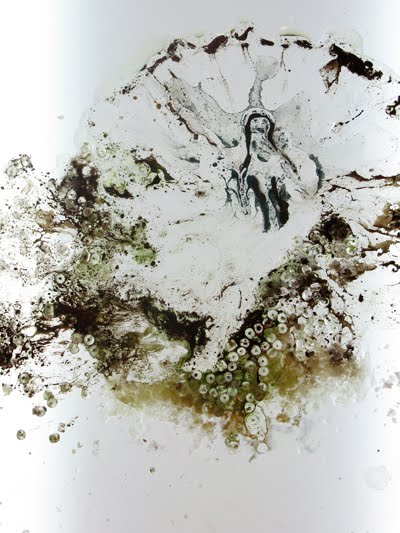
I don't want the animation to be too gloomy, after all it is about a journey and personal growth as much as it is about the events that occurred. There were always glimmers of hope even in my worst moments. A night out with friends, sexual encounters, a good drawing, people being nice to me, all of these things helped get me through so they should also be included. The ego panel isn't the place for any real negativity, I will save my vitriol for the shadow.


I didn't notice until I got home that the focus lock wasn't on so the camera kept changing the focus, also the lights in the light-box were fluctuating quite a lot. Usually if the shutter is open for about 1 second this eliminates the flicker but in order to get the contrast right I had to drop the shutter speed as I was using glass beads on a white background.
This is the stage in which to make my mistakes as I am really looking at how to develop the imagery, in essence how to get from one scene to another. It's a little like rehearsing for a play, as long as I practice and develop the animation. The early outcomes are deemed a success or failure depending on how much I have learned from the experience not whether the animations themselves are 'perfect'. I will likely end up with a number of animations which will each have their own positive qualities as well as points which haven't worked.
I feel good about what I achieved in the 1st real session and I am booked into the room on Friday too so I get a day to consider the outcomes before I rework the animation. I will make sure the focus lock is on and also have a look at which noise (there are three noises) means that the image is being captured as I think I am not getting out of the way fast enough when the camera is on the time-lapse function. I discovered that using the washing-up liquid with the oil and pigment can have some interesting effects. If I use quite a lot of pigment with a little oil to make a thick mixture I can use it on top of the washing-up liquid to make a definite line.
The way that the detergent and oil behave together is nice to work with. The substances resist one another instead of mixing which allows me to isolate the pigment and 'draw' in the liquid. This is definitely something that needs to be explored further.
Ego 1
You can clearly see that I had problems with the focus as well as the light-box. I am having to animate for panels that will be portrait as opposed to landscape so I have to animate this way up, you will just have to turn your screen on it's side to view!
I am getting to know my medium well now so I feel that there has been a little more skill involved in the manipulation process. I have to be careful not to get the paintbrush or fingers in shot. I feel that the end part, when the rice is introduced is the weakest part. I would like to bring Duncan's presence into the animation but I don't like the style or how literal the figures are. I think it loses some of it's appeal when the rice appears so I won't use that again. The glass beads were effective though so I will get more of those for Friday. I brought some paint pigment to work with today so will try that out tomorrow too.
Thursday, 6 May 2010
Art and Psychoanalysis by Laurie Schneider Adams
Schneider Adams, L. (1994) Art and Psychoanalysis. New York: HarperCollins Publishers Inc.
I picked several books out of the library before Easter but this is the one that seems to have aided my research more than the others especially in relation to use of unconscious techniques like dream journalling.
The book is steeped in Freudian analysis and doesn't mention much of Jung. This was a bit of a disappointment but as Jung studied under Freud I cannot discount his work no matter how I feel about it personally. One of the issues that I have with Freud is that much of his theory has a male bias and neglects the female perspective. As the subject of my own analysis I have to look at theory that (if gender related) pertains to my own gender. This book covers a lot of ground looking at the Oedipus Complex but this theory was initially based on the relationship that a male child has with his parents, Jung's Electra complex comes a bit closer to the female perspective. I find that a lot of Freudian theory glosses over the female perspective as if being male himself stopped him being able to empathise with the opposite sex.
Once I had got over my fear of Freud and all his talk of penis-envy I started to enjoy sections of this book and found it to be quite helpful. I took Suzie's advice and didn't try to read the whole book. I have issues with reading so sometimes that can make it hard to carry out my research. I read the introduction and got a better idea of which sections would be the most beneficial to my research.
The following is the list of contents with the relevant sections highlighted:
I found that another trick that enabled me to extract as much information as possible from the book was to find the right place to read it. I have found that waiting rooms are an excellent place to read as nobody will disturb you and they are usually comfortable with a good source of light. It's very important to me that there are no disturbances when I am trying to read so waiting rooms are perfect. It has been suggested to me that I should just read in the library but my aversion to library's and an desire to be unconventional means that the library is not ideal. I attended a lecture last week and despite the dim lighting I found that I could also concentrate better on reading in there. Of course I wasn't listening to the lecture but I found it easier to block out one person talking than to block out loads of people talking and moving, as the audience were quiet and sat still it eliminated a lot of noise and movement from my surroundings.
The Psychological Impact of Imagery
Boundary Loss: Ego and Image
As animation is an area that is commonly associated with 'cartoons' and character it can be hard to break away from that. As I have chosen something more abstract and that has taken me down some fairly heavy theoretical avenues I have encountered some opposition to my current line of enquiry. Some of my peers have expressed concern that I might 'go too deep' and lose what it is that people can identify with. This is something that I am concerned about as I don't really want to alienate a large section of my viewers but I cannot help but be drawn in this direction.
I have had a few years of teaching others and helping them find inspiration for their own work and this has changed the way in which I work. I included very little theory in my BA work and had problems applying the theory in my dissertation, opting to ramble about my own point of view instead of considering the opinion of experts. Teaching has given me a different perspective and fostered an appreciation of the thoughts of others.
Although the author was specifically discussing static work similar rules can be applied to moving image, although if sound is present this changes somewhat. Animations like Normal McLaren's Begone Dull Care (1949) use abstract imagery alongside music to create something that the viewer is compelled to watch:
Watching something like this is not that dissimilar to watching the work of a good choreographer. People do seem compelled to watch image and sound that have been synchronised even if the images are non-figurative. An example of this in popular culture is the itunes visualiser:
The visualiser is not that far removed from the lighting used in nightclubs to enhance the emotional impact of the music. This gives the viewer/listener a all encompassing experience, using lights and music to forge an atmosphere that encourages movement. Many different genres of music utilize visual devices for live performances and this is a developing industry which has it's beginnings in the 'Disco' era with lights, mirror-balls and smoke machines. More recent developments include music video, laser light shows the advent of the VJ.
Many VJ's now use a more figurative approach by using film footage and animated characters, not unlike an impromptu music video. This could be influenced by the same psychology that affects enjoyment of abstract imagery. In a way this isn't as important when the visuals are intended for use in a live music venue as the people viewers are more like participants as they are often there to dance and socialise as well as to observe the visuals and listen to the music.
When sound and image are used together the effect on the viewer can have more impact than a static image alone. This is something that wasn't covered Art and Psychoanalysis as it focussed on classic examples. I seem to be caught between abstract painting, music and moving image and it's very hard to find theory that fits in with my current work. I have found that it's helpful to strip it down to the essentials of psychology.
I picked several books out of the library before Easter but this is the one that seems to have aided my research more than the others especially in relation to use of unconscious techniques like dream journalling.
The book is steeped in Freudian analysis and doesn't mention much of Jung. This was a bit of a disappointment but as Jung studied under Freud I cannot discount his work no matter how I feel about it personally. One of the issues that I have with Freud is that much of his theory has a male bias and neglects the female perspective. As the subject of my own analysis I have to look at theory that (if gender related) pertains to my own gender. This book covers a lot of ground looking at the Oedipus Complex but this theory was initially based on the relationship that a male child has with his parents, Jung's Electra complex comes a bit closer to the female perspective. I find that a lot of Freudian theory glosses over the female perspective as if being male himself stopped him being able to empathise with the opposite sex.
Once I had got over my fear of Freud and all his talk of penis-envy I started to enjoy sections of this book and found it to be quite helpful. I took Suzie's advice and didn't try to read the whole book. I have issues with reading so sometimes that can make it hard to carry out my research. I read the introduction and got a better idea of which sections would be the most beneficial to my research.
The following is the list of contents with the relevant sections highlighted:
- 1 Beginnings
- 2 Freud's Leonardo: The Controversy
- 3 The Psychological Impact of Imagery
- 4 Art and the Oedipus Complex
- 5 Dreams, Delusions and Art
- 6 Michelangelo's Moses and Other Michelangelo Problems
- 7 The Transitional Object and Its Implications for Creativity and Symbolism
- 8 Some Psychological Aspects of the Mother-Child Relationship in Western Art
- 9 Psychoanalytic Readings of Primal-Scene Iconography
- 10 Biography, Autobiography, and Psychology
- 11 Psychobiography: Caravaggio, Artemisia, Brancusi
- 12 Aesthetics on Trial: Whistler vs. Ruskin
I found that another trick that enabled me to extract as much information as possible from the book was to find the right place to read it. I have found that waiting rooms are an excellent place to read as nobody will disturb you and they are usually comfortable with a good source of light. It's very important to me that there are no disturbances when I am trying to read so waiting rooms are perfect. It has been suggested to me that I should just read in the library but my aversion to library's and an desire to be unconventional means that the library is not ideal. I attended a lecture last week and despite the dim lighting I found that I could also concentrate better on reading in there. Of course I wasn't listening to the lecture but I found it easier to block out one person talking than to block out loads of people talking and moving, as the audience were quiet and sat still it eliminated a lot of noise and movement from my surroundings.
The Psychological Impact of Imagery
Boundary Loss: Ego and Image
"When such twentieth-century styles as Abstract expressionism and Minimalism appeared, viewers' responses by and large suggested that their ego boundaries were even more threatened than they were by illusionism. Rather than evoking a sense of the uncanny, however, nonobjective art aroused anger. The artist's skill was denied rather than admired. Such responses had previously appeared in the nineteenth-century view of Impressionism as technically inferior to the clear edges and precise textures of Neoclassical painting"
As animation is an area that is commonly associated with 'cartoons' and character it can be hard to break away from that. As I have chosen something more abstract and that has taken me down some fairly heavy theoretical avenues I have encountered some opposition to my current line of enquiry. Some of my peers have expressed concern that I might 'go too deep' and lose what it is that people can identify with. This is something that I am concerned about as I don't really want to alienate a large section of my viewers but I cannot help but be drawn in this direction.
I have had a few years of teaching others and helping them find inspiration for their own work and this has changed the way in which I work. I included very little theory in my BA work and had problems applying the theory in my dissertation, opting to ramble about my own point of view instead of considering the opinion of experts. Teaching has given me a different perspective and fostered an appreciation of the thoughts of others.
"Psychologically, it would seem, those who respond negatively to nonobjective imagery do so because there is no recognisable figure or object with which to identify. "
Although the author was specifically discussing static work similar rules can be applied to moving image, although if sound is present this changes somewhat. Animations like Normal McLaren's Begone Dull Care (1949) use abstract imagery alongside music to create something that the viewer is compelled to watch:
Watching something like this is not that dissimilar to watching the work of a good choreographer. People do seem compelled to watch image and sound that have been synchronised even if the images are non-figurative. An example of this in popular culture is the itunes visualiser:
The visualiser is not that far removed from the lighting used in nightclubs to enhance the emotional impact of the music. This gives the viewer/listener a all encompassing experience, using lights and music to forge an atmosphere that encourages movement. Many different genres of music utilize visual devices for live performances and this is a developing industry which has it's beginnings in the 'Disco' era with lights, mirror-balls and smoke machines. More recent developments include music video, laser light shows the advent of the VJ.
Many VJ's now use a more figurative approach by using film footage and animated characters, not unlike an impromptu music video. This could be influenced by the same psychology that affects enjoyment of abstract imagery. In a way this isn't as important when the visuals are intended for use in a live music venue as the people viewers are more like participants as they are often there to dance and socialise as well as to observe the visuals and listen to the music.
When sound and image are used together the effect on the viewer can have more impact than a static image alone. This is something that wasn't covered Art and Psychoanalysis as it focussed on classic examples. I seem to be caught between abstract painting, music and moving image and it's very hard to find theory that fits in with my current work. I have found that it's helpful to strip it down to the essentials of psychology.
Friday, 30 April 2010
Video Triptych Examples
One of the e-mails that I received today was the NUCA Alumni 'Events for May'. One of the exhibitions included a video triptych by Nicola Naismith, who is a NUCA graduate.
Source [Accessed on 30/04/10]
Although I have been unable to find any video of this work online I did find some other examples of video triptychs and found it helpful to watch how they function. It gives me a good idea of how the action should occupy the space.
Example 1
Unknown student artist

As the synopsis states this video triptych deals with the personality differences between rebel/negotiator/soldier and their relationship with authority. In a sense this triptych is fairly relevant to my own work as it endeavours to show differing emotive qualities. I intend to give each part of my triptych it's own personality but still show how each portion interacts with its neighbour, not unlike the previous example.
Just watching examples has given me a much clearer idea of how some of the action will need to be isolated so as to ensure that the viewer doesn't become confused (unless that is my intention). As previously stated in my proposal the ego is the centre of consciousness and as such will be placed in the centre of the triptych.
As the Ego deals with perception and memory I feel that I should relate this part to my 'black book', using the entries and memories contained within to inspire the imagery on the centre 'panel'. The Shadow and Persona panels can offer their response to the 'memories' depicted in the Ego portion of the triptych. The previous example used 3 faces/heads, one in each panel, which is quite a literal interpretation and focuses on the human interactions. As my work is concerned with the interrelationship of the human psyche rather than human to human interactions I must carefully consider what methods will best convey this.
Example 2
No More Sheepless Nights by Dario Vacirca
Information on Dario Vacirca's residency
Residency blog
Although Dario Vacirca is the most acclaimed artist of the three I cannot relate to his triptych in the same way that I could relate to the first one. I have no doubt that this has a lot to do with the human element involved in the 1st triptych. However, if I didn't have any information about what the 1st triptych was about I'm not sure that I would have related to it in the same way. As I read the 'blurb' before I watched the video it gave me a context in which to view the work. It begs the question 'should art have to be explained in order to be understood?' Dario Vacirca gives very little explanation as to what is behind his triptych aside from saying that it addresses 'solitude and time'. This adds to the ambiguity but also goes some way in distancing the viewer from what is happening on screen.
Example 3
Flow by Jeff Winch
Information on Jeff Winch
Art at Toronto Zoo
Each of the 3 example triptychs contain elements that encourage me to think about my own work. 'Flow' uses figures in the foreground to add a new dimension to the work. It then feels like work within work. This has rekindled my initial desire to use projections that are then filmed to produce the final piece. I like this kind of layered approach as it gives the viewer more to think about and can often offer a compelling enigma to those who watch.
I think that I will stick with a running time of 3 minutes for my triptych. The 2nd and 3rd examples seem too long. It must be hard to limit the time on video work as it is filmed in real-time rather than having to be animated frame-by-frame. Animators have a tendency to keep things as short as possible due to the labour intensive methods that are often involved in producing animation. I estimate that 3 minutes of animation (for one panel) will take me roughly 5 or 6 hours, and this may well have to be performed over and over until I get it right. I had been considering if I should animate the triptych as if it were one animation, then slice it up in post-production or if I should animate each panel separately and coordinate the movement so that he panels appear to interact. I am inclined to veer towards producing the panels separately and possibly having the camera get closer to the subject on each panel (left to right, persona to shadow) in order to reflect the depth of conscious removal.
Video Triptych2003
Featured in the 14 Person Minutes installationVideo Triptych is a series of ambiguous moving images. Is the movement generated by human (traditional) or mechanical (technological) means? A traditional tool performs to camera creating a new position for the needle and thread. Replacing its traditional function, the object has become through technological processes a platform on which to discuss modes of production. The alliance of differing prosthetics creates a position within contemporary art that bridges field of skill and knowledge. This video work is a response to the question: What might be hand made and what might be machine processed?
Video Triptych 2003 video (2 minutes 30 seconds)


Source [Accessed on 30/04/10]
Although I have been unable to find any video of this work online I did find some other examples of video triptychs and found it helpful to watch how they function. It gives me a good idea of how the action should occupy the space.
Example 1
Unknown student artist

As the synopsis states this video triptych deals with the personality differences between rebel/negotiator/soldier and their relationship with authority. In a sense this triptych is fairly relevant to my own work as it endeavours to show differing emotive qualities. I intend to give each part of my triptych it's own personality but still show how each portion interacts with its neighbour, not unlike the previous example.
Just watching examples has given me a much clearer idea of how some of the action will need to be isolated so as to ensure that the viewer doesn't become confused (unless that is my intention). As previously stated in my proposal the ego is the centre of consciousness and as such will be placed in the centre of the triptych.
Ego
o Handles the communication between the Persona and Shadow
o Centre of consciousness
o Personal identity and purpose
o Perception
o Memory
o Feelings
As the Ego deals with perception and memory I feel that I should relate this part to my 'black book', using the entries and memories contained within to inspire the imagery on the centre 'panel'. The Shadow and Persona panels can offer their response to the 'memories' depicted in the Ego portion of the triptych. The previous example used 3 faces/heads, one in each panel, which is quite a literal interpretation and focuses on the human interactions. As my work is concerned with the interrelationship of the human psyche rather than human to human interactions I must carefully consider what methods will best convey this.
Example 2
No More Sheepless Nights by Dario Vacirca
Information on Dario Vacirca's residency
Residency blog
Although Dario Vacirca is the most acclaimed artist of the three I cannot relate to his triptych in the same way that I could relate to the first one. I have no doubt that this has a lot to do with the human element involved in the 1st triptych. However, if I didn't have any information about what the 1st triptych was about I'm not sure that I would have related to it in the same way. As I read the 'blurb' before I watched the video it gave me a context in which to view the work. It begs the question 'should art have to be explained in order to be understood?' Dario Vacirca gives very little explanation as to what is behind his triptych aside from saying that it addresses 'solitude and time'. This adds to the ambiguity but also goes some way in distancing the viewer from what is happening on screen.
Example 3
Flow by Jeff Winch
Information on Jeff Winch
Art at Toronto Zoo
Each of the 3 example triptychs contain elements that encourage me to think about my own work. 'Flow' uses figures in the foreground to add a new dimension to the work. It then feels like work within work. This has rekindled my initial desire to use projections that are then filmed to produce the final piece. I like this kind of layered approach as it gives the viewer more to think about and can often offer a compelling enigma to those who watch.
I think that I will stick with a running time of 3 minutes for my triptych. The 2nd and 3rd examples seem too long. It must be hard to limit the time on video work as it is filmed in real-time rather than having to be animated frame-by-frame. Animators have a tendency to keep things as short as possible due to the labour intensive methods that are often involved in producing animation. I estimate that 3 minutes of animation (for one panel) will take me roughly 5 or 6 hours, and this may well have to be performed over and over until I get it right. I had been considering if I should animate the triptych as if it were one animation, then slice it up in post-production or if I should animate each panel separately and coordinate the movement so that he panels appear to interact. I am inclined to veer towards producing the panels separately and possibly having the camera get closer to the subject on each panel (left to right, persona to shadow) in order to reflect the depth of conscious removal.
Dreaming and My Dream Journal
I have been having a little more success with my dream journal recently as I have been able to recall my dreams more frequently of late. My dream journal is handwritten and I write every dream in it that I can remember. I have been able to notice themes emerging as the time has gone on and the process of recollecting and recording my dreams has in itself helped me with my interpretations.
The recollection process seemed simple to me when I initially thought about keeping a dream diary or journal. I quite often think about the dreams I have had upon waking and I neglected to realise that the process of documentation might be quite different to simply recalling a dream. The mechanisms involved in writing down something as abstract as a dream are rather strange.
Upon waking from a dream the most imposing memory is of the emotion that the dream evoked, it's imprint staying for some time after other parts of it are forgotten. After this I start to recall the events and piece together the events. I sometimes have a strong impression of the last part of my dream and when recalling this I start to remember what came before. It's a lot like as if you were asleep at the start of a film and stated to slowly wake as you reach the end.
What I end up with inside my head does not always lend itself well to writing. I find that dreams can skip from one thing to another and sometimes I am not even sure that I am recalling events in order, just that it seems like the most logical order I can come up with. This again relates to Gestalt theory as dreams are often so surreal that our waking brain will have to work hard to make sense of what has occurred. I find myself writing things like:
"My dream kept flitting between..."
"In the next bit of the dream..."
"...was very jumbled..."
"The dream changes and then..."
"...a little dream interlude..."
Sometimes I am unsure when writing down my dreams if I am inventing the bits in between the parts I can remember. I find sometimes that I recall having small dreams almost like commercial breaks in a larger dream. I wonder if I invent notions like walking through a door, or up stairs, or travelling somewhere in order to make sense of one dream ending and another beginning? This is especially important when writing dreams down. To 'play' them in your head is not the same as explaining them on paper.
[needs link to Dream Theory post, quote from pg 41]
I had been concentrating on the content of my dreams, analysing it for meaning and looking for patterns. I often go through phases of dreaming about a particular place, person or event. Sometimes parts of the dream are merely imprints of things that I remember from that day. These things have often passed by in my waking world without drawing much attention from my conscious mind, but they seem to have got the attention of my unconscious enough that they are recalled.
There are quite a few areas to look at:
I keep feeling that it might be helpful to have someone other than myself to make an analysis of my dreams so that I don't miss something that is glaringly obvious from the outside. Analysing oneself can never be done in an unbiased way as we will naturally see things only in our own context. If I could find someone well versed in psychology maybe they could give a differing insight into the dreams and their potential meanings.
Although I am investigating my dreams and unconscious mind for this project I also realise that the knowledge that I may gain from this could help me to understand myself better. Its my opinion that knowing yourself is the pathway to understanding others.
As I now have quite a few entries in my dream journal its probably time to start looking for themes that are repeated. I will start by isolating the people, places and scenarios that occur and taking note of how many times each of these things occur. It might help to simplify things by distilling 'river' 'sea' and 'swimming pool' into the umbrella title of 'Water'. This way I will be able to deal with a large number of dreams and be able to get a general picture before I look into it in more depth.
The recollection process seemed simple to me when I initially thought about keeping a dream diary or journal. I quite often think about the dreams I have had upon waking and I neglected to realise that the process of documentation might be quite different to simply recalling a dream. The mechanisms involved in writing down something as abstract as a dream are rather strange.
Upon waking from a dream the most imposing memory is of the emotion that the dream evoked, it's imprint staying for some time after other parts of it are forgotten. After this I start to recall the events and piece together the events. I sometimes have a strong impression of the last part of my dream and when recalling this I start to remember what came before. It's a lot like as if you were asleep at the start of a film and stated to slowly wake as you reach the end.
What I end up with inside my head does not always lend itself well to writing. I find that dreams can skip from one thing to another and sometimes I am not even sure that I am recalling events in order, just that it seems like the most logical order I can come up with. This again relates to Gestalt theory as dreams are often so surreal that our waking brain will have to work hard to make sense of what has occurred. I find myself writing things like:
"My dream kept flitting between..."
"In the next bit of the dream..."
"...was very jumbled..."
"The dream changes and then..."
"...a little dream interlude..."
Sometimes I am unsure when writing down my dreams if I am inventing the bits in between the parts I can remember. I find sometimes that I recall having small dreams almost like commercial breaks in a larger dream. I wonder if I invent notions like walking through a door, or up stairs, or travelling somewhere in order to make sense of one dream ending and another beginning? This is especially important when writing dreams down. To 'play' them in your head is not the same as explaining them on paper.
[needs link to Dream Theory post, quote from pg 41]
I had been concentrating on the content of my dreams, analysing it for meaning and looking for patterns. I often go through phases of dreaming about a particular place, person or event. Sometimes parts of the dream are merely imprints of things that I remember from that day. These things have often passed by in my waking world without drawing much attention from my conscious mind, but they seem to have got the attention of my unconscious enough that they are recalled.
There are quite a few areas to look at:
- Who is in my dream?
- Where does the dream take place?
- What emotions do I feel during the dream?
- Is there anything 'mundane' that has been selected from my conscious mind?
- Putting the dream in the context of your waking life.
- Symbol analysis, looking for archetypes.
I keep feeling that it might be helpful to have someone other than myself to make an analysis of my dreams so that I don't miss something that is glaringly obvious from the outside. Analysing oneself can never be done in an unbiased way as we will naturally see things only in our own context. If I could find someone well versed in psychology maybe they could give a differing insight into the dreams and their potential meanings.
Although I am investigating my dreams and unconscious mind for this project I also realise that the knowledge that I may gain from this could help me to understand myself better. Its my opinion that knowing yourself is the pathway to understanding others.
As I now have quite a few entries in my dream journal its probably time to start looking for themes that are repeated. I will start by isolating the people, places and scenarios that occur and taking note of how many times each of these things occur. It might help to simplify things by distilling 'river' 'sea' and 'swimming pool' into the umbrella title of 'Water'. This way I will be able to deal with a large number of dreams and be able to get a general picture before I look into it in more depth.
Friday, 23 April 2010
Software, hardware and all things technical
Today has been mostly spent trying to set up the equipment required to capture animation. As I will need to begin animating ASAP, and will need to animate regularly (once or twice each week) my options are somewhat limited.
The animation resource at NUCA is overstretched at this time of year as the BA students are working towards their deadline. This means that we have to make other arrangements if we want to regularly use the resource in between now and when the BA's hand their work in. I have spoken to the workshop manager (Sam) and he has agreed to let me use a room that is currently used as a storage area. I have my own DSLR and laptop so my only real equipment needs are a rostrum and lightbox, both of which are available through the animation resource.
During my BA I opted to just use the Canon remote capture facility that came with my Canon Eos DSLR instead of using any animation software. This process involved using the remote facility to lock the camera settings and capturing straight onto my hard drive. As I didn't use any animation software, I had to use Quicktime Pro to make the stills into a movie each time I wanted to see a shot. This was not too much of a problem as I prefer not to look until I have produced something more substantial than a few seconds.
The issues that I have with my current camera are mostly to do with software. I currently own a Nikon D5000 which comes with it's own software that enables the user to download the images onto the computer from the camera/memory card. Unlike the Canon software, Nikon does not offer a remote capture or 'tethering' facility. Initially I couldn't even get the Nikon software to work on my operating system (Mac OS 10.6.2) but after a bit of fiddling around with updates I managed to get it to work.
I looked at several pieces of tethered shooting software but found that a lot of the free software available was either incompatible with the Mac OS or with my camera. I found one piece of software that I tried called Sofortbild at first glance it seemed that this piece of software might be sufficient but after a few tests it became apparent that it didn't have the capabilities that I had hoped for. When shooting I will need to use a time-lapse function in order to keep my hands free and maintain consistency when using fluids to animate. I found that when using the time-lapse facility on the sofortbild software that it would change the camera settings between shots, altering the light and leading to flickering. Sam and I had a look to see if we could do anything to remedy this but it seemed that the software wasn't capable of locking the settings during time-lapse photography.
I decided to look at the stop-motion software that is available with my set-up and the two main contenders are Dragon Stop-motion and iStopMotion both of these pieces of software are quite expensive. At first I thought that the iStopMotion software might be quite cheap as it said that there were versions available from $49. However, the version available at the lower price didn't support HD formats so wouldn't have been suitable for this project. As shown on the table below, only the Pro version (costing $499 for a single license) had HD capabilities.

There seemed to be no educational discount for the iStopMotion software and paying $499 (£325) is not an option for me at the moment.
Dragon Stop Motion does offer an educational discount, but it is only available when purchased by an educational institution.

Suzie said that there may be some money in the budget to buy a (Dragon) license or two for students to use. I decided to download the trial version of Dragon to check it's compatibility with my camera and OS.
The initial tests were encouraging but I found that using Dragon in conjunction with my DSLR was a bit slow and clunky. When using Dragons time-lapse facility the shutter release seemed to be inconsistent. Even though the time-lapse was programmed to release the shutter every few seconds sometimes it would seem to stall and take longer for some frames. This wasn't too much of a problem as the lighting was looking suitably consistent but I found that the battery on my camera wasn't lasting long enough so I looked at the possibility of buying an AC adaptor. The adaptor would have cost a little over £100, which again is not something that I can afford at the moment.
All of this left me feeling a little disappointed, as I feel that my financial situation is of my own doing. I made a decision that I would only take on a minimum of paid work this year to give me some time and space to work on my MA as I didn't want to repeat any mistakes that I made during my BA when I was working over 30 hours a week on top of my course. Getting the work/MA balance right has been difficult. In the 1st year of the MA I was also finishing of my teaching diploma as well as working, which was too much in terms of workload but it meant that I was better off financially as I was in receipt of a loan and bursary. This year I made sure that the bulk of my workload occurred between September and February, leaving time free during the Masters project. This has been great when it comes to the theory and 'thinking' behind my work as it has given me some much needed space in which to develop my ideas. This is what I have too tell myself when I hit an obstacle that is related to money, if I had the money I wouldn't have the time. As nice as it was to be able to spend money on my BA project it would have been nicer not to have to get up at 5am every weekday morning!
So I will wait.
After spending weeks trying to find a technical solution that works I must admit defeat, wait until the BA students have finished and use the resources available at NUCA instead of using my own equipment.
The animation resource at NUCA is overstretched at this time of year as the BA students are working towards their deadline. This means that we have to make other arrangements if we want to regularly use the resource in between now and when the BA's hand their work in. I have spoken to the workshop manager (Sam) and he has agreed to let me use a room that is currently used as a storage area. I have my own DSLR and laptop so my only real equipment needs are a rostrum and lightbox, both of which are available through the animation resource.
During my BA I opted to just use the Canon remote capture facility that came with my Canon Eos DSLR instead of using any animation software. This process involved using the remote facility to lock the camera settings and capturing straight onto my hard drive. As I didn't use any animation software, I had to use Quicktime Pro to make the stills into a movie each time I wanted to see a shot. This was not too much of a problem as I prefer not to look until I have produced something more substantial than a few seconds.
The issues that I have with my current camera are mostly to do with software. I currently own a Nikon D5000 which comes with it's own software that enables the user to download the images onto the computer from the camera/memory card. Unlike the Canon software, Nikon does not offer a remote capture or 'tethering' facility. Initially I couldn't even get the Nikon software to work on my operating system (Mac OS 10.6.2) but after a bit of fiddling around with updates I managed to get it to work.
I looked at several pieces of tethered shooting software but found that a lot of the free software available was either incompatible with the Mac OS or with my camera. I found one piece of software that I tried called Sofortbild at first glance it seemed that this piece of software might be sufficient but after a few tests it became apparent that it didn't have the capabilities that I had hoped for. When shooting I will need to use a time-lapse function in order to keep my hands free and maintain consistency when using fluids to animate. I found that when using the time-lapse facility on the sofortbild software that it would change the camera settings between shots, altering the light and leading to flickering. Sam and I had a look to see if we could do anything to remedy this but it seemed that the software wasn't capable of locking the settings during time-lapse photography.
I decided to look at the stop-motion software that is available with my set-up and the two main contenders are Dragon Stop-motion and iStopMotion both of these pieces of software are quite expensive. At first I thought that the iStopMotion software might be quite cheap as it said that there were versions available from $49. However, the version available at the lower price didn't support HD formats so wouldn't have been suitable for this project. As shown on the table below, only the Pro version (costing $499 for a single license) had HD capabilities.

There seemed to be no educational discount for the iStopMotion software and paying $499 (£325) is not an option for me at the moment.
Dragon Stop Motion does offer an educational discount, but it is only available when purchased by an educational institution.

Suzie said that there may be some money in the budget to buy a (Dragon) license or two for students to use. I decided to download the trial version of Dragon to check it's compatibility with my camera and OS.
The initial tests were encouraging but I found that using Dragon in conjunction with my DSLR was a bit slow and clunky. When using Dragons time-lapse facility the shutter release seemed to be inconsistent. Even though the time-lapse was programmed to release the shutter every few seconds sometimes it would seem to stall and take longer for some frames. This wasn't too much of a problem as the lighting was looking suitably consistent but I found that the battery on my camera wasn't lasting long enough so I looked at the possibility of buying an AC adaptor. The adaptor would have cost a little over £100, which again is not something that I can afford at the moment.
All of this left me feeling a little disappointed, as I feel that my financial situation is of my own doing. I made a decision that I would only take on a minimum of paid work this year to give me some time and space to work on my MA as I didn't want to repeat any mistakes that I made during my BA when I was working over 30 hours a week on top of my course. Getting the work/MA balance right has been difficult. In the 1st year of the MA I was also finishing of my teaching diploma as well as working, which was too much in terms of workload but it meant that I was better off financially as I was in receipt of a loan and bursary. This year I made sure that the bulk of my workload occurred between September and February, leaving time free during the Masters project. This has been great when it comes to the theory and 'thinking' behind my work as it has given me some much needed space in which to develop my ideas. This is what I have too tell myself when I hit an obstacle that is related to money, if I had the money I wouldn't have the time. As nice as it was to be able to spend money on my BA project it would have been nicer not to have to get up at 5am every weekday morning!
So I will wait.
After spending weeks trying to find a technical solution that works I must admit defeat, wait until the BA students have finished and use the resources available at NUCA instead of using my own equipment.
Subscribe to:
Posts (Atom)
